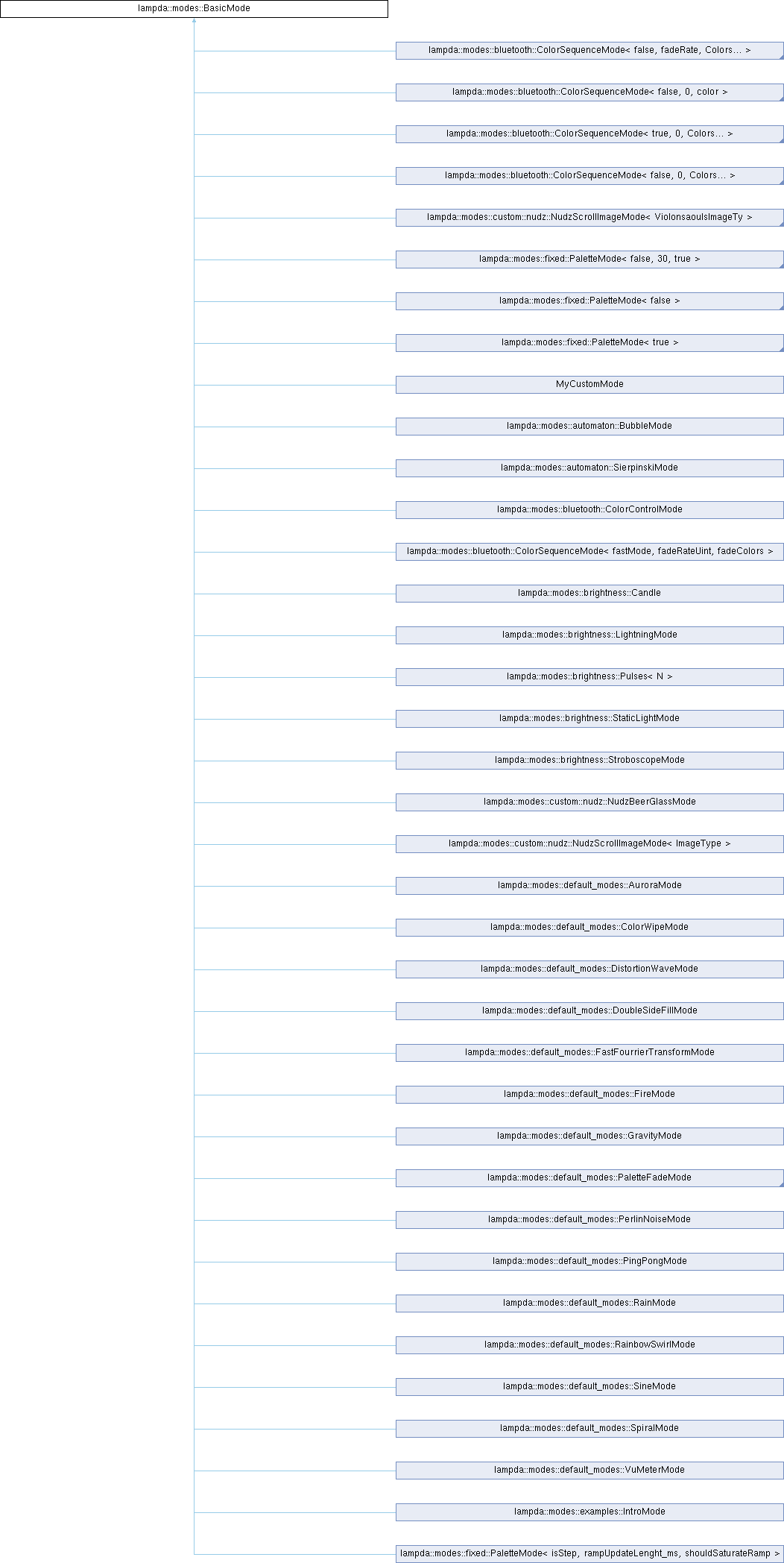
Parent object for all custom user modes. More...
#include <mode_type.hpp>
Classes | |
| struct | StateTy |
| Mode custom static state, made available through context (optional) More... | |
Static Public Member Functions | |
| static void | loop (auto &ctx) |
| Custom user mode loop function (default) | |
| static void | on_enter_mode (auto &ctx) |
| Custom callback when mode gains focus (optional) | |
| static void | on_exit_mode (auto &ctx) |
| Custom callback when mode goes outside of focus (optional) | |
| static void | sunset_update (auto &ctx, float progress) |
| Custom callback when sunset mode is updated (optional) | |
| static void | brightness_update (auto &ctx, brightness_t brightness) |
| Custom callback when brightness changes (optional) | |
| static void | custom_ramp_update (auto &ctx, uint8_t rampValue) |
| Custom callback when system sets user ramp (optional) | |
| static uint8_t | get_custom_ramp_default_value (auto &ctx) |
| Return the custom ramp default value, in case no preset is used. | |
| static bool | custom_click (auto &ctx, uint8_t nbClick) |
| Custom "usermode" button UI for "click" action (optional) | |
| static bool | custom_hold (auto &ctx, uint8_t nbClickAndHold, bool isEndOfHoldEvent, uint32_t holdDuration) |
| Custom "usermode" button UI for "click+hold" action (optional) | |
| static void | power_on_sequence (auto &ctx) |
| Custom callback when the system powers on (optional) | |
| static void | power_off_sequence (auto &ctx) |
| Custom callback when the system powers off (optional) | |
| static void | read_parameters (auto &ctx) |
| Custom callback to read parameters from filesystem (optional) | |
| static void | write_parameters (auto &ctx) |
| Custom callback to write parameters to filesystem (optional) | |
| static void | user_thread (auto &ctx) |
| Custom secondary loop, executed in another thread (optional) | |
Static Public Attributes | |
| static constexpr bool | isGroupManager = false |
| static constexpr bool | hasSunsetAnimation = false |
| Toggles the use of custom BasicMode::sunset_update() callback. | |
| static constexpr bool | hasBrightCallback = false |
| Toggles the use of custom BasicMode::brightness_update() callback. | |
| static constexpr bool | hasCustomRamp = false |
| Toggles the use of custom ramps & BasicMode::custom_ramp_update() | |
| static constexpr bool | hasButtonCustomUI = false |
| Toggles "usermode" button UI custom_click() and custom_hold() | |
| static constexpr bool | hasSystemCallbacks = false |
| Toggles advanced system callbacks, see list here . | |
| static constexpr bool | requireUserThread = false |
| Toggles the use of custom BasicMode::user_thread() callback. | |
| static constexpr uint32_t | storeId = 0 |
| Store identifier for persistent storage (optional) | |
Detailed Description
Parent object for all custom user modes.
Implement a custom user mode as follow:
Once defined, you can enable the mode by adding it to indexable_functions.cpp :
You can start from the mode template below where you will need to remove the unused callbacks:
Further examples of modes are available in src/modes/default
Member Function Documentation
◆ brightness_update()
|
inlinestatic |
Custom callback when brightness changes (optional)
Callback active only if BasicMode::hasBrightCallback is True
- Parameters
-
[in] ctx The current context [in] brightness The brightness value set by the system
- Remarks
- Use update_brightness() to change brightness in order for this callback to be correctly handled at runtime
◆ custom_click()
|
inlinestatic |
Custom "usermode" button UI for "click" action (optional)
Callback active only if BasicMode::hasButtonCustomUI is True
- Parameters
-
[in] ctx The current context [in] nbClick The number of clicks made by the user
- Returns
- Returns True if default UI action should be prevented
◆ custom_hold()
|
inlinestatic |
Custom "usermode" button UI for "click+hold" action (optional)
Callback active only if BasicMode::hasButtonCustomUI is True
- Parameters
-
[in] ctx The current context [in] nbClickAndHold The number of clicks made by the user [in] isEndOfHoldEvent True if the user just released the button [in] holdDuration The duration of the on-going hold event
- Returns
- Returns True if default action must be prevented
- Remarks
- When
isEndOfHoldEventis True, thenholdDurationis zero
◆ custom_ramp_update()
|
inlinestatic |
Custom callback when system sets user ramp (optional)
This can be used to make a mode configurable through the 3H click+hold user action, which will cycle through the 0-255 values in a ~2s ramp
- Parameters
-
[in] ctx The current context [in] rampValue The custom value set by the user
- Remarks
- This behavior is in user::button_hold_default() and may be prevented if custom "usermode UI" via custom_hold() is enabled
◆ loop()
|
inlinestatic |
Custom user mode loop function (default)
Loop function each tick called whenever the mode is set as the currently active mode by the user
- Parameters
-
[in] ctx The current context, providing a interface to the local state, the mode manager, as well as the hardware through its lamp object
◆ on_enter_mode()
|
inlinestatic |
Custom callback when mode gains focus (optional)
- Parameters
-
[in] ctx The current context
◆ on_exit_mode()
|
inlinestatic |
Custom callback when mode goes outside of focus (optional)
- Parameters
-
[in] ctx The current context
◆ power_off_sequence()
|
inlinestatic |
Custom callback when the system powers off (optional)
Callback active only if BasicMode::hasSystemCallbacks is True
- Parameters
-
[in] ctx The current context
- Remarks
- This must be a non-blocking function
◆ power_on_sequence()
|
inlinestatic |
Custom callback when the system powers on (optional)
Callback active only if BasicMode::hasSystemCallbacks is True
- Parameters
-
[in] ctx The current context
- Remarks
- This must be a non-blocking function
◆ read_parameters()
|
inlinestatic |
Custom callback to read parameters from filesystem (optional)
Callback active only if BasicMode::hasSystemCallbacks is True
- Parameters
-
[in] ctx The current context
◆ sunset_update()
|
inlinestatic |
Custom callback when sunset mode is updated (optional)
Callback active only if BasicMode::hasSunsetAnimation is True
- Parameters
-
[in] ctx The current context [in] progress Between 0 and 1, progress of the sunset. At 1, the system turns off
◆ user_thread()
|
inlinestatic |
Custom secondary loop, executed in another thread (optional)
Called only if BasicMode::requireUserThread is True
- Parameters
-
[in] ctx The current context
- Remarks
- This is executed as prologue of user::user_thread() and hence must complete quickly in order to keep the lamp responsive
◆ write_parameters()
|
inlinestatic |
Custom callback to write parameters to filesystem (optional)
Callback active only if BasicMode::hasSystemCallbacks is True
- Parameters
-
[in] ctx The current context
Member Data Documentation
◆ hasCustomRamp
|
staticconstexpr |
Toggles the use of custom ramps & BasicMode::custom_ramp_update()
- Remarks
- Without this set to True, manager will NOT save custom ramp value!
◆ hasSystemCallbacks
|
staticconstexpr |
Toggles advanced system callbacks, see list here .
Required to use any of the following:
- BasicMode::power_on_sequence(),
- BasicMode::power_off_sequence()
- BasicMode::read_parameters()
- BasicMode::write_parameters()
- Remarks
- By default, these callbacks are called for all modes (not only the active one) and thus should be kept minimal
◆ requireUserThread
|
staticconstexpr |
Toggles the use of custom BasicMode::user_thread() callback.
- Remarks
- When this is enabled, default is to call hardware::LampTy's
show()in user::user_thread() after the BasicMode::user_thread() callback
◆ storeId
|
staticconstexpr |
Store identifier for persistent storage (optional)
By default, all modes are reset upon a shutdown, providing no persistence of their state across several on/off cycles. To expose to the user a way to configure your mode in a persistent fashion, you can use:
This value is configurable through user interaction with the button. If you need a persistent value, private to your mode, you can use:
These are the two always-available persistent state that a mode can configure by default. However, for more advanced modes (like games, with a list of high-scores, for example) more flexibility can be required.
If you need such extended storage, see ContextTy::KeyProxy for usage.
If you don't need these capabilities, just ignore this identifier :)
The documentation for this struct was generated from the following file:
- src/modes/include/mode_type.hpp